GU10 and MR16 Downlight Housings and Frames
A housing is a fitting, not a light. It holds a GU10 or MR16 lamp in the ceiling, sets the cut-out and carries the finish. The lamp goes on a separate order line.
The part that meets the ceiling
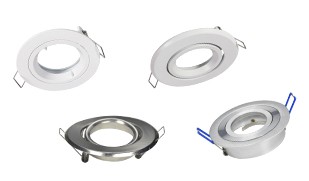
With GU10 and MR16 downlights, the frame or housing is what the installer actually handles. It sets the cut-out (F1), carries the visible trim (F2), determines how the fitting is fixed (F11) and provides the finish people see. The lamp sits inside it and is chosen separately, which is why we treat housings as products in their own right.
Frames come round or square, fixed or tilting, in several finishes. Whether a particular frame tilts, and how far, is a per-model fact on its drawing.
GU10 or MR16: the lamp base sets the rules
GU10 lamps use a twist-and-lock two-pin base and normally run directly from the mains supply. The housing needs a GU10 lamp holder and enough depth for the lamp you plan to use.
MR16 names the reflector format, not the base or the voltage: lamps in that format come with different bases and run at different voltages, so the base has to be named and the voltage confirmed separately. Where the chosen lamp is a low-voltage bi-pin type, it needs a transformer or driver matched to it, and the installation needs a place for that driver to sit.
Lamp length varies between lamp makers, so measure F3 with the lamp fitted, not on the bare housing. If the lamp brand changes mid-project, check the depth again.
Aluminium, iron, plastic
- Aluminium. Light, carries heat away from the lamp well, and takes a clean painted or brushed finish. Common where the finish is on show.
- Iron. Rigid and economical, with a painted finish. Heavier than aluminium for the same frame.
- Plastic. Light and electrically non-conductive. Check heat suitability against the lamp you intend to use; that pairing is confirmed per model.
Material is F10 on our checklist and is always stated per model.
| Code | Field | Why it matters | Value for your model |
|---|---|---|---|
| F1 | Cut-out size | The hole in the ceiling. On a retrofit it has to match the hole that’s already there; on a new build the hole is cut to this figure. Check shape as well as size. | per-model — confirm on spec sheet |
| F2 | Face diameter | The visible trim; it has to cover the cut edge, and it’s the part people see. | per-model — confirm on spec sheet |
| F3 | Body height | Depth with the lamp fitted. Lamp length varies by lamp maker, so measure with the lamp you’ll use. | per-model — confirm on spec sheet |
| F10 | Housing material | Aluminium, iron or plastic. Affects weight, finish and how heat leaves the body. | per-model — confirm on spec sheet |
| F11 | Mounting | Recessed or surface, plus the fixing method. Surface models need no cut-out, so F1 drops out of the check. | per-model — confirm on spec sheet |
| F12 | Warranty | Varies by model. Take the term from the spec sheet of each model on the order, never from a family. | per-model — confirm on spec sheet |
Measuring an existing hole for a housing swap? Start with the cut-out size chart.
List the housings and the lamps as separate lines
Tell us the lamp base, the hole you measured and the finish you need. We confirm F1, F2, F3, F10, F11 and F12 from each model’s sheet.